
Mong Indigenous People: Erased from History and Excluded from Societies
Issues of Classification, Erasure, and The Right to Self-Determination

Paper
prepared for the 19th Session of the United Nation Expert
Mechanism on the Rights of Indigenous Peoples 13-17
July, 2026 mongheritage@gmail.com
Mong Indigenous People: Erased from History and Excluded
from Societies
Issues of Classification, Erasure, and The Right to
Self-Determination
Introduction
Across contemporary
national and international systems, ethnic and national identities play a
critical role in shaping access to rights, cultural preservation, and historical
recognition. Yet not all groups are afforded equal acknowledgment. The Mong
Indigenous People represent one such community whose distinct identity remains
largely suppressed and unrecognized. This paper examines the historical,
political, and social factors contributing to the marginalization, suppression,
and cultural erasure on the Mong, highlighting the consequences of
classification issues and advocating for Mong recognition as a fundamental
human right grounded in the international laws.
Historical Background
The Mong is an ancient
people with deep historical roots across Northern and Eastern Asia, including
regions that are now the Northern Steppes and Northern China. For centuries,
Mong contributed to the cultural, historical, and political development of these
regions. Mong ancestors played significant roles in the formation and
administration of various kingdoms.
Historical sources confirm
the presence and participation of Mong peoples in governance and state structures
associated with the Tuam Tshoj country (大朝国), Yuan, Song, and Tang
dynasties, as well as other polities referenced in classical records (Song,
Volumes 17; Zhen, Southern Song; Gong, Southern Song; Liu, Later Jin; Cha,
2025). For examples, Sui Dynasty was known as the Mong Guo (蒙国 Mong
Country); the Old Tang Book refers to the Tang sovereignty as the Mong Country
and Tang elites were Mong; the northern capital region of Liao was known as
Mong Country; the Song Dynasty was also known as the Mong Country and the
government was known to be Mong; older literatures recorded that Genghis Khan's
people were Mong and their country was Tuam Tshoj ;
and the Yuan official records refer to the people of the lower Yellow River
Basin as Mong (Liu, Later Jin; Historical Record of Liao; Historical Record
of Song; Gong, Southern Song; Song,
1369-1370; Historical Record of Yuan). These records support a longstanding
of Mong nation and historical presence that extends beyond contemporary
classifications.
Following the
establishment of the People's Republic of China (PRC), diverse ethnic groups
were systematically categorized into official classifications for
administrative and political purposes (Mullaney, 2011). Fifty-six national
groups were defined and Mong was excluded as one of the national groups.
Among the approved classifications, Mong populations in various regions were
reclassified with other communities into several national groups, including
Han, Miao, Mongolian, Tu (Turkic), and others (Cha, 2025: Ch. 2, 460-466).
In southwestern China,
Mong established communities and are the descendants from Mong refugees who hid
in the mountains and canyons after the fall of Mong Yuan Dynasty.
As an example of issues of
classification, many Mong were subsumed with the
Hmong/Miao Man communities into the official category of Miaozu
(Cha, 2025: 460-466). The misclassification, misrecognition, or
misrepresentation of these Mong into Hmong/Miao were then accepted into the
Southeast Asia and the West administrative systems according to the narrative
approved by the PRC government.
Over time, some Mong
groups (蒙/盟) were misrecognized under Hmong (苗族) due to their inclusion within the broader
Hmong/Miao category. Mong national history and heritage are not acknowledged
while Hmong/Miao history and cultural identity were documented and recognized as
a whole. These systems, though administratively efficient, have contributed to
the blurring and in some cases, erasure of distinct ethnic identities (Gladney,
1994). While these classifications served state organizational needs, it also
initiated a process of reinterpretation and redefinition of historical
literatures for the approved national groups leading to the diminishing of Mong
history and people.
The Mong contributions and
Mong states or countries are often absent in modern historical narratives,
particularly where they do not align with prevailing nations their defined
national histories and national ethnic frameworks. This has led to no dedicated academic study or research
focused specifically on the Mong history and identity. The result is not only the marginalization of Mong people
in the present but also a gradual erasure of Mong presence from the past
history itself.
Distinguishing Mong and Hmong Identities
Historical records reflect
different written characters for the Mong name (蒙/盟) and
Hmong name (苗族/蛮夷). Both have separate origins and unique
cultural developments. These names are not merely linguistic variations or
different spellings; they represent distinct historical narratives, cultural
lineages, and identities.
Mong (蒙/盟)
The Mong people historically inhabited the Northern
Steppes and the Yellow River Basin (YRB) long before the 2200 B.C. to the 14th century
A.D. and are recorded under the characters 盟 and later 蒙. As
outlined in the Historical Background section, the Mong established and
governed multiple kingdoms, supported by distinct historical accounts. In the
last several centuries, they emigrated into the south. During these periods,
Mong ancestors are described as having 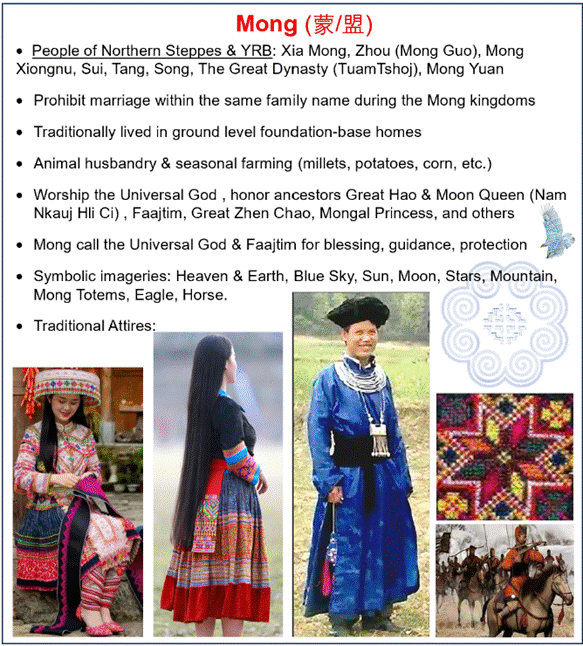 authority over various groups, including the
Huayi (majority Han), the Miao Manyi, and others (Liu, Later Jin).
authority over various groups, including the
Huayi (majority Han), the Miao Manyi, and others (Liu, Later Jin).
The Mong built metropolitan cities and traditionally lived
in ground-level, foundation-based homes. Among communities outside major urban
centers the ancient Mong way of life centered on animal husbandry, including
raising horses, cattle, sheep, goats, and pigs, alongside with seasonal
farming. This lifestyle often involved groups relocating periodically in search
of suitable land and resources.
Mong spiritual traditions center on the worship of the
Universal God, often understood as the Blue-Sky God, as well as the Thunder God.
We honor our ancestral and historical figures such as the Great Hao, Faajtim, Modu, the Great Zhen Chao (aka Temozhen
or Tiemuzhen), the Mongal
Princess, and others. In our beliefs and rituals, Mong guide the deceased
spiritually to reunite with Faajtim as our ancestral
origin. Mong invoke Faajtim and the Great Zhen Chao
for protection and blessing.
Mong also created state laws which strictly prohibit
marriage within the same family name. This law was rigorously enforced during
the Mong kingdoms.
Mong symbolic imagery reflects our cosmology and
environment, including heaven and earth, the sun and moon, the blue sky, the
mountains, thunder (often represented as a lord or lightning dragon), as well
as other symbolic icons such as eagle and horse. Horsemanship has long been a
part of the Mong way of life.
Traditional Mong clothing includes women wearing wax-batik and
embroidered dresses or skirts with leggings, long coats with turbans or head scarves;
men wear loose baggy pants with sashes, long embroidered coats, and turbans or
hats. Both would wear curled-toe shoes or boots. These traditional attires are
associated with historical periods such as the Mong Xiongnu,
Mong Tuam Tshoj, Mong Yuan eras, and other northern
sovereignties.
Hmong (苗族/蛮夷)
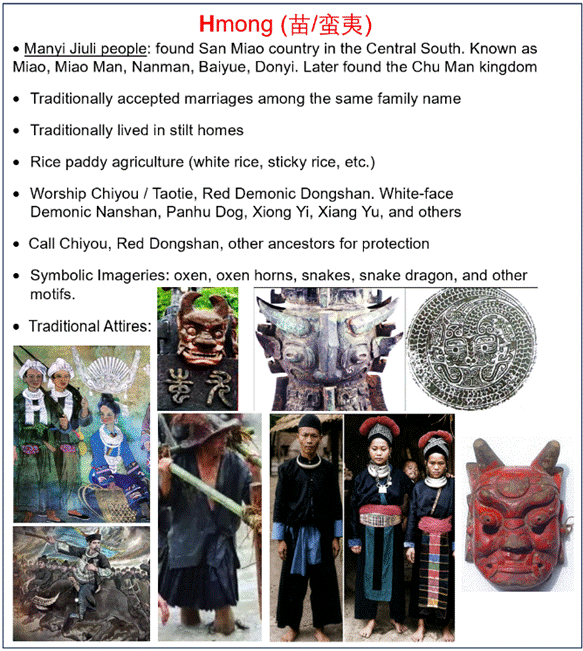 Hmong Miaozu
history and heritage existed in the Central and Southern China since the last
4,000 years. They lived along the Yangtze River, Hunan, Guangxi, and the
Southwest. Their historical accounts are predominantly documented under the
characters 苗族 and 蛮夷 (Wu. 1997; Zong, 2007) which Miaozu is the same as Hmong in Western contexts (Tapp,
2001).
Hmong Miaozu
history and heritage existed in the Central and Southern China since the last
4,000 years. They lived along the Yangtze River, Hunan, Guangxi, and the
Southwest. Their historical accounts are predominantly documented under the
characters 苗族 and 蛮夷 (Wu. 1997; Zong, 2007) which Miaozu is the same as Hmong in Western contexts (Tapp,
2001).
The "Hmong people" were historically identified as the
Manyi of Jiuli and later referred to as San Miao, the
Miao Min, Miao Man, Nanman, Man Wuling, Man Changsha,
Man Panhu, and Dongyi in various records. Hmong
communities honor their ancestral figure Chiyou,
calling upon him for strength and guidance. Within their spiritual traditions,
they also revere their paternal ancestor known as the Eastern Red Demonic Dongshan and their maternal ancestor referred to as the
Southern White Demonic-faced Nanshan, both of whom are invoked for protection.
In addition, figures such as the Panhu Dog, Xiong Yi,
and Xiang Yu are regarded within their broader ancestral and cultural heritage.
Traditionally, the Hmong lineage has been connected to lowland environments
near water sources, where rice paddy cultivation has long been a central and
sustaining aspect of their way of life. Their ancient living arrangement and
environment reflect their symbolic icons of the oxen, oxen horns, snake,
snake-dragon; and traditionally lived in stilt homes (Wu, 1997; Zong,
2007) occasionally keeping their livestock underneath.
The marriage custom among the same family names were more
relaxed in the past, and it is still the same among their communities in China which
aligns with the Huayi Donyi culture. However, since the last couple of
centuries, many Hmong Miaozu who lived among the Mong
assimilated with the Mong marriage-customary law.
Hmong women traditionally wear [cropped] pants same as
those wore by Zhuang, Buyi, and Huayi and occasionally wear plain skirts as an
assimilation. They were part of the Ming society and culture of the Manyi and
Huayi which Ming government supported (Zhang, Qing period). Their men also wore
plain white skirts during that time and switched to wearing cropped pants
during Qing period.
It is clear that Mong and
Hmong are distinctively different. These differences are highly visible among
those in China. Their histories, ancestors, cultural customs, and rituals are
not the same. The Mong and Hmong languages are different, and one is not a
subgroup of the other (Thao, 2024).
Equating Mong identity
with Hmong oversimplifies complex histories and undermines the integrity of both
communities. Subsuming Mong under Hmong while excluding the Mong ancestral
history and culture has led to suppression and ethnic conversion under the name
of inclusion. Misrecognizing the Mong culture, custom, and other elements as
belonging to Hmong violates the cultural protection right of the Mong. Teaching
Hmong language, culture, and history to the Mong as belonging to them is
inappropriate. The result is ethnic oppression, forced assimilation, and
cultural erasure. This is clearly a violation of human right and ethnocide.
While there may be
instances of historical interaction or assimilation among the groups that led
to similarity in language and culture, such complexities should not be used to
justify the reclassification or absorption of one identity into another. The
solution does not lie in redefining one group as the other, but in recognizing
both. The Hmong individuals who rightfully identify with their San Miao heritage
have the right to assert and protect their Hmong Miao identity. Respecting this
self-identification is essential which Hmong Miao is globally being recognized.
Likewise, this right and recognition of the Mong language, history, and
cultural identity must extend equally to the Mong Indigenous people.
Lack of Formal Recognition of the Mong
Indigenous People and Nation
Mong people and historical
culture are not formally recognized as distinct within national or international
systems. This absence directly contradicts international legal principles
affirming the right to self-identification and cultural existence (UNDRIP,
Article 33). Lack of recognition or issues of classification has led to
multiple challenges and consequences.
1.
Cultural and Historical Erasure on the Mong
The omission or misrepresentation of Mong language and
people in education and public discourse constitutes a form of cultural
erasure. Under UNDRIP Article 8, such processes may be understood as forms of
forced assimilation when they systematically undermine a group s identity.
Mong unique language and cultural practices are being
defined as belonging to others or being a subset of another group under the
circumstances of ethnic classification issues and ethnic misrepresentation.
This led to the elimination of Mong historical identity and culture.
2.
Mong faced Systemic Reclassification
Mong individuals are required to
identify under other ethnic categories to access essential services such as
education, healthcare, and legal protections. This conflicts with protections
outlined in the ICCPR (Article 27) and ICESCR (Article 1), which affirm the
rights of minorities to maintain their own identity and cultural practices.
This systemic reclassification, while administrative in intent,
accelerates the erosion of [Mong] identity both within countries of origin and
across diaspora communities (Gladney, 2004).
3.
Restrictions on Mong Cultural and Identity
Expression
In certain contexts, public discussion or teaching of
Mong identity is limited and discouraged, particularly when it falls outside
officially recognized national ethnic frameworks. Educational systems often
exclude Mong specific content or reinterpret it through dominant
classifications. These types of treatments restrict opportunities for cultural
preservation (Tapp, 2001).
Limitations on teaching, expressing, or preserving Mong
language-cultural identity hinder the exercise of cultural rights protected
under both the UDHR (Article 27) and UNESCO cultural heritage conventions.
4.
Digital Misrepresentation on The Mong
In the digital age, misrepresentation on the Mong
Indigenous people persists across online platforms and modern Artificial Intelligence (AI). Search engines and databases frequently
misrepresent the Mong identity under
other national groups through inaccurate, misleading, or derogatory
definitions. AI systems are
trained on existing information that often contains inaccurate and biased
representations of the Mong people.
For instance, in Baidu search engine and AI systems of
Asia, Mong people is either nonexistent or associate with the Mongolians.
This undermines the integrity of both identities. The name Mong is also
associate with Mongol, further complicating efforts to preserve and
communicate the Mong's authentic identity. Stem from
the term Mongoloid, Mong is also used in derogatory contexts in the English
language resulting in censorship in various digital platforms on the internet.
Though many modern English dictionaries label Mong as an outdated offensive
term, it continues to exist in contemporary usage as a [British] slang
referring to intellectual disability, clumsiness, or foolishness (Oxford
University Press, 2023; Cambridge University Press, 2023) and is derogatory for
being stupid or retarded. This persistence highlights how stigmatizing language
can remain embedded in everyday discourse despite formal acknowledgment of its
offensiveness. The result has caused significant harm to the Mong people,
including emotional distress, lowered self-esteem, internalized racism, and a
diminished sense of belonging.
In another example in Google search engine, it does not
recognize Mong people or Mong Ethnic, instead, Google misrepresents Mong people
for being a subgroup under Hmong Miao people and defines Mong as a derogatory
meaning. This misrepresentation harms the Mong, and it makes it difficult for
[Mong] communities to protect elements such as their history, traditional
clothing, and heritage practices (Anderson, 2006). Accurate representation is a
cultural right.
5.
Absence of Demographic Data on The Mong
Without formal recognition, there is no reliable census or demographic data
documenting Mong populations globally. Mong communities are not being counted,
studied, or supported in policy frameworks. This absence creates structural
exclusion, undermining participation in social, economic, and cultural life.
This makes Mong invisible and not part of society. Without data, the community
effectively does not exist in policy and research contexts (United Nations,
2007).
Legal and Human Rights Frameworks
International law provides
a solid foundation for recognizing the rights of distinct cultural and ethnic
groups, including those not formally acknowledged. The United Nations Universal
Declaration of Human Rights (UDHR) establishes that all individuals are
entitled to dignity, identity, and cultural participation without
discrimination (United Nations, 1948, Articles 1, 2, and 27).
The International Covenant
on Civil and Political Rights (ICCPR) further affirms in Article 27 that persons
belonging to ethnic, religious, or linguistic minorities shall not be denied
the rights to enjoy their own culture, to profess and practice their own
religion (ancestral faith), or to use their own language (United Nations,
1966).
The International Covenant
on Economic, Social and Cultural Rights (ICESCR) reinforces these protections
by recognizing the right of all peoples to self-determination and cultural
development (United Nations, 1966, Article 1).
Most significantly, the United
Nations Declaration on the Rights of Indigenous Peoples (UNDRIP) explicitly
affirms:
Similarly, the UNESCO
Convention for the Safeguarding of the Intangible Cultural Heritage (2003)
emphasizes the responsibility of states and international communities to protect
cultural diversity and ensure the transmission of intangible heritage across
generations.
These frameworks
collectively establish that recognition is not merely symbolic it is a legal
and moral obligation tied to fundamental human rights.
The Right to Self-Determination and
Recognition
Currently, Mong people
across several countries including democratic nations have not been granted the
right to self-determination. As a result, the Mong identity remains unrecognized.
Mong need the right to self-determination and recognition.
International law is
clear: self-identification is a protected right, and cultural diversity is a
global value that must be preserved. Recognition of the Mong identity aligns
directly with the international human rights and principles for the protection of
cultural diversity and the inclusion of marginalized communities. United
Nations frameworks, including the Declaration on the Rights of Indigenous Peoples,
affirm the rights of communities to self-identification and cultural
preservation (United Nations, 2007).
Official recognition will
give the Mong representation and an independent voice. Mong people s concerns
can be heard and addressed while supporting their right to self-determination.
This would pave the way for Mong history, cultural identity, and language to be
taught in public education so the Mong can be counted, studied, and supported in
policy frameworks. Such inclusion would not only affirm and validate Mong
identity but also play a vital role in preserving Mong language, cultural
heritage, safeguarding historical knowledge, and upholding the dignity of the
community.
Conclusion
The Mong is a distinct
people with distinct language, history, and cultural identity. Issues of
classification and misrepresentation violate the Mong's
civil and human rights, distorting the Mong language, culture, and history; and
inflicting lasting harms to those who remain committed to the Mong heritage.
This paper calls upon the United Nations and the international community to
recognize the Mong Indigenous people, address the historical and ongoing harms
inflicted upon the Mong, eliminate the derogatory usage of the name
"Mong," and formally recognize "Mong" as a distinct people
in English dictionaries, literature, academic publications, digital platforms,
and across the internet.
The call for recognition
of the Mong Indigenous people is clear and measured. It is not a challenge to
the dominance of any contemporary nations or groups, but a plea for
self-determination. What is needed is inclusion based on the Mong language,
history, and cultural identity, and a commitment from entities such as United Nations
and its subsidiaries, universities, and national systems along with the
international communities to recognize the Mong to ensure that no people are
marginalized or erased.
_______________________________________
References
Anderson, B. (2006). Imagined Communities:
Reflections on the Origin and Spread of Nationalism (Rev. ed.). Verso.
Cambridge University Press. (2023). Cambridge Dictionary (Entry on Mong ).
Cha, T. (2025). Mong China History and
Heritage Preservation. Fresno, California. Updated Electronic Version [from
the hardcopy (2013), China Gold Printing Group, China]. ISBN 978-0-9888518-2-5.
85-86, 212-228, 231, 243, 245-254, 260-263, 275, 287-317, 338, 460-466.
Gladney, D. C. (1994). Representing
Nationality in China: Refiguring Majority/Minority Identities. The Journal
of Asian Studies, 53(1), 92 123.
Gladney, D. C. (2004). Dislocating
China: Muslims, Minorities, and Other Subaltern Subjects. University of
Chicago Press.
Gong, Z. (Written during Southern Song). Mong Tataar Records. 3. [赵珙,《蒙鞑备录 国号年号》: 去年春,珙每见所行文字,犹日 大朝 .] Reference in Cha, 2025: 294-299.
Historical Record of Liao (Compiled during Yuan period). Volume 37, Treatise 7, Geography I. [ 辽史 , 第三十七卷, 志第七, 地理志一] Reference in Cha, 2025: 275.
Historical Record of Song. Volume 293:
Biographies 52, 249 and others. [ 宋史, 卷二百九十三 列传第五十二 & 列传第二百四十九 (二十四史全译)]. Reference in Cha, 2025: 307-314.
Historical Record of Yuan. Volume 65:
Rivers and Canals (2). Beijing Guoxue Shidai Cultural Communication Co., Ltd. [ 元史, 卷六十五: 河渠二, 北京国学时代文化传播有限公司]
Liu, X. (Later Jin). Old Tang Book:
Biography of Du Rangneng; Biographies of Vol. 144
(Part II) & The Turks (Part II) and Other Biographies. [刘昫 (后晋),旧唐书, 卷一, 本纪第一; 列传第一百四十四 下 突厥下] Reference in Cha, 2025: 224-228, 231, 243, 245-254, 260-263, 287-317.
Mullaney, T. S. (2011). Coming to
Terms with the Nation: Ethnic Classification in Modern China. University of
California Press.
Oxford University Press. (2023). Oxford English
Dictionary (Entry on Mong ).
Song, L (1369-1370). Yuan Historical
Record. Volume 17 (part 1): Water Canals (2). [ 元史, 宋濂 (369年至1370年), 志第十七上: 河渠二.]
Tapp, N. (2001). The Hmong of China:
Context, Agency, and the Imaginary. Brill.
Thao, P. & Yang, C. (2024). The Mong
and the Hmong. Mong Journal. Volume 1: 13-14.
United Nations. (1948). Universal
Declaration of Human Rights.
United Nations. (1966a). International
Covenant on Civil and Political Rights.
United Nations. (1966b). International
Covenant on Economic, Social and Cultural Rights.
United Nations. (2007). United Nations
Declaration on the Rights of Indigenous Peoples.
UNESCO. (2003). Convention for the
Safeguarding of the Intangible Cultural Heritage.
Wu, RongZhen, and others (1997). Hmong National History [Haiv Hmoob Liv Xwm]. Lub Koom Haum
Txuj Hmoob. Printed by SSP Makati (Philippines), 44-46, 55-56, 60-62, 82-86, 198-200, 425, 429-432, 487, 553-554.
Zhen, Dexiu (Written during Southern Song). Pleading for Donations to Aid Xinzhou s
Drought Devastation. [真德秀, 南宋朝 《乞施行饶信州旱伤》, 〈九月日发〉] Reference in Cha, 2025: 307-309.
Zong, Zhubian, and others (2007). Hmong [Miaozu] National Comprehensive
History, Beijing: Renmin Chu Banshe, Volume 1,
1-17, 25-27. [总主编, 吴荣臻, 副总主编, 苗族通史, 北京: 人民出版社, (一), 1-17, 25-27.]
Zhang, T. (Qing period). Historical
Record of Ming. Treatises Vol. 16: Geography I Treatise Vol. 75. Manyi
Officials. [张廷玉, 明史, 志第十六 地理一:志第七十五 (二十四史全译). 蛮夷长官, 蛮长官 ]